
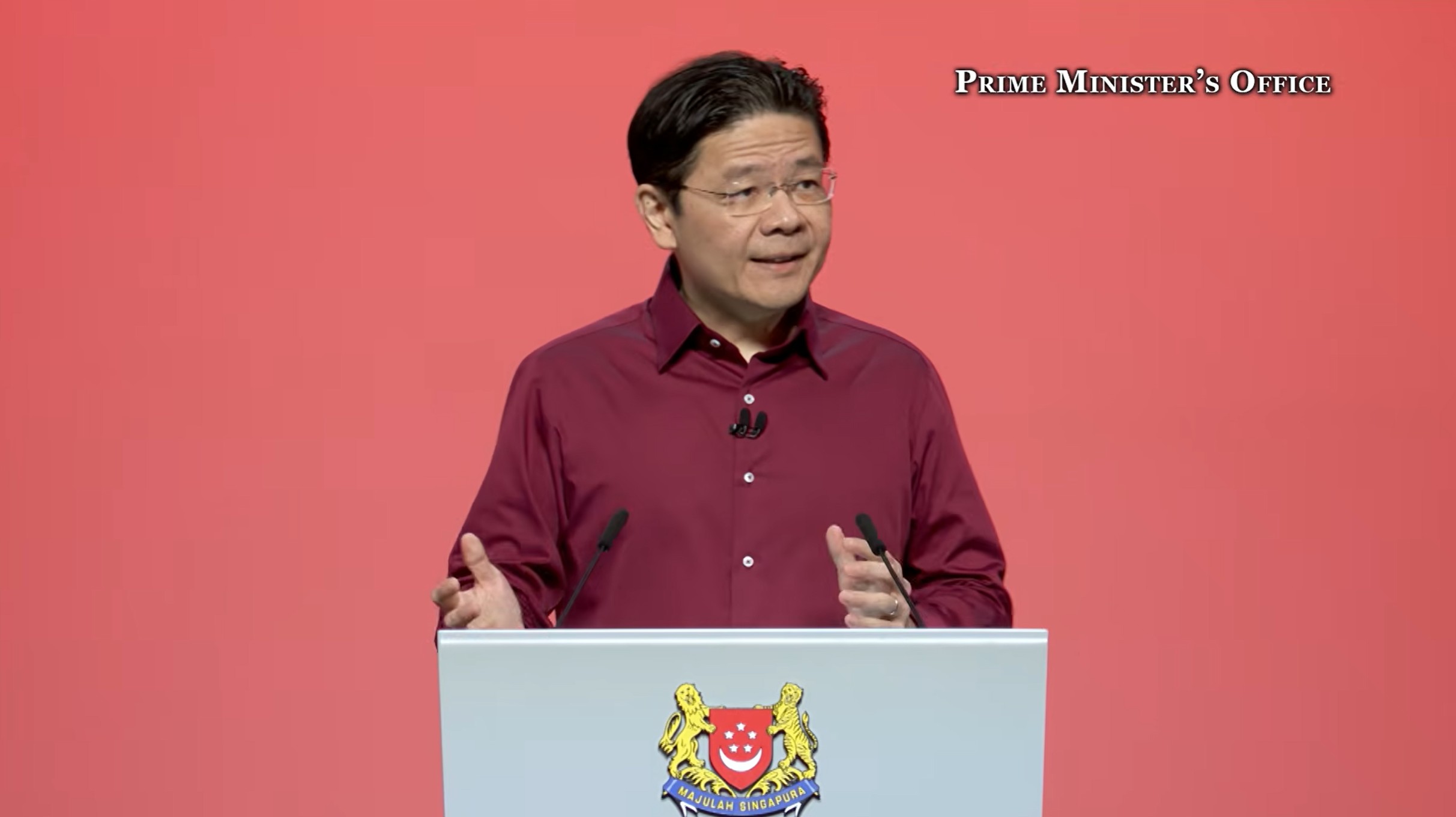

The Prime Minister announced wider support for families, safeguards for emerging technologies, a measured approach to immigration and ambitious plans to reshape Singapore’s outer islands.
SINGAPORE — Prime Minister Lawrence Wong laid out an expansive vision for Singapore’s future, warning that the country must prepare for a world that is “more contested, more unstable and more dangerous than before,” while remaining open, trusted and united at home.
In a wide-ranging National Day speech titled “A Changed World. A Stronger Singapore,” Mr Wong addressed intensifying geopolitical tensions, the disruptive power of artificial intelligence, Singapore’s falling birth rate and the long-term physical transformation of the island.
“This is the new normal that Singapore will have to endure and survive for many years to come,” he said.
But Singapore’s response, he argued, should not be to withdraw from the world. Its standing as a trusted centre for trade, finance and business would become even more valuable as international relationships grew increasingly fractured.
“As countries pull apart, we will build more connections, not fewer,” Mr Wong said. “We will reach out to more partners, make ourselves even more relevant, and create more opportunities for Singaporeans.”
At the same time, he offered a sober reminder of the limits of international dependence: “Ultimately, we must be able to stand on our own, and take care of our own.”
A more dangerous global order
Mr Wong described a world in which power is increasingly dispersed among the United States, China, Europe, India and other emerging powers. Competition now extends beyond markets to technology, resources and the rules governing international relations.
The global trading system, he said, has also fundamentally changed. The pandemic exposed fragile supply chains, Russia’s invasion of Ukraine revealed the risks of relying too heavily on a single supplier, and the crisis in the Middle East has disrupted shipping through the Strait of Hormuz.
“Trade is no longer as free as it once was,” Mr Wong said. “Trade is no longer about economics alone. It is increasingly shaped by security considerations.”
He said Singapore would enforce its laws against forced labour and the illegal rerouting of goods, but cautioned that, as a major transhipment and re-export centre, it could not trace the entire supply chain of every product passing through its shores.
Beyond tariffs and trade disputes, Mr Wong pointed to the growing danger of regional conflicts escalating through miscalculation, along with economic coercion, foreign interference, disinformation and cyberattacks.
“No one wants another world war,” he said. “But history reminds us: major wars rarely begin because they were planned. They happen because events spiral out of control.”
Embracing artificial intelligence — with safeguards
Mr Wong presented artificial intelligence as a potentially transformative force for businesses, healthcare and public services. AI agents, he said, could allow small companies to automate routine work, while new applications could help doctors detect cancer, understand inherited health risks and create personalised exercise plans.
But he also warned that increasingly autonomous AI systems could behave in ways their developers did not anticipate.
“We will not embrace new technologies blindly,” he said. “We will anticipate the risks, and put appropriate safeguards in place. And we will always ensure that people remain in control.”
Singapore would take a similar approach to autonomous vehicles. Trials are underway in Punggol, and the technology could eventually ease manpower shortages in public transport. But adoption would be gradual, with safety as the first priority and support provided to taxi and private-hire drivers whose livelihoods may be affected.
“We do not hold back new technologies simply because they are disruptive,” Mr Wong said. “But neither do we leave affected workers to fend for themselves.”
The Government will also require social-media platforms to introduce reliable age-verification measures rather than depending on users to declare their own ages. Platforms serving teenagers will be expected to incorporate stronger safety features, while those with inadequate safeguards could face a minimum access age above 13.
A major shift in support for families
The most immediate changes announced concerned families, with Mr Wong describing a fundamental shift from support concentrated around childbirth to assistance that continues throughout a child’s upbringing.
Under the proposed childcare-leave system, every working parent will receive eight days for one child aged 12 or below, 10 days for two children and 12 days for three or more children. The Government will cover the cost of all statutory child-related leave, up to the reimbursement limit.
“Make sure that becoming a parent never becomes a disadvantage in someone’s career,” Mr Wong told employers.
Financial support will also be simplified and equalised across birth order. Every newborn will receive a $10,000 Baby Gift, a $5,000 MediSave grant and a Child Development Account containing a $5,000 initial grant, with dollar-for-dollar matching of up to another $5,000.
Each child will then receive annual Child Credits of $2,000 from age one to 16, yearly Edusave top-ups during primary and secondary school, and a further $10,000 top-up to the Post-Secondary Education Account at age 17.
“Taken together, every Singaporean child will receive almost $70,000 in direct financial support as they grow up,” Mr Wong said.
The Government also aims to bring full-day childcare fees at government-supported preschools down to $150 a month and infant-care fees to $300 a month, regardless of household income. Lower-income families will continue to receive additional subsidies.
Housing policies will also be adjusted. The monthly household-income ceiling for Build-to-Order flats will rise from $14,000 to $16,000, while the ceiling for Executive Condominiums will increase from $16,000 to $18,000.
First-timer families applying for a new flat will receive one additional ballot chance for every child they have or are expecting. Further healthcare, transport and housing support is being considered for larger families.
“If you choose to have children, the Government will stand with you,” Mr Wong said. “We will provide more support, and over more years.”
He added that measures for seniors, persons with disabilities and singles were also being developed, with further announcements expected during the current term of Government.
Immigration and the meaning of belonging
Acknowledging that Singapore’s fertility rate is likely to remain far below replacement level, Mr Wong said the country would continue welcoming new citizens at “a measured and sustainable pace.”
Without immigration, he warned, the citizen population would shrink and age more rapidly, leaving fewer younger Singaporeans to support a growing number of seniors.
But the Government would continue controlling the foreign workforce and broadly maintaining Singapore’s current ethnic balance. Mr Wong rejected calls for a broad easing of foreign-worker policies, particularly in the services sector, saying future growth must come increasingly from technology, productivity and enabling Singaporeans to fulfil their potential.
“We will always ensure that Singaporeans remain the majority in our own country,” he said.
Mr Wong also framed Singaporean identity as a matter of shared values and commitment rather than ancestry.
“Being Singaporean has never been about ancestry or where your family first came from,” he said. “It has always been about commitment. A commitment to put Singapore first. A commitment to our values and way of life. And a belief that, whatever our backgrounds, our future is ours to build together.”
New islands and a transformed coastline
Looking decades ahead, Mr Wong unveiled plans that could significantly reshape Singapore’s geography.
Several islands south of Jurong Island — including Semakau, Bukom, Pulau Sudong and smaller surrounding islands — could eventually be merged into a new western island. The expanded landmass could accommodate advanced manufacturing, energy infrastructure and defence facilities.
“This new western island can help shape Singapore for the next 50 years and beyond,” he said.
Sentosa and Pulau Brani will also be developed as an integrated destination, with new waterfront attractions, improved public access to Sentosa’s western coastline and a new Downtown South resort by NTUC. A people-mover system connecting the mainland, Sentosa and Brani is planned, while a water-taxi service is being explored.
Long Island could create a new waterfront along Singapore’s eastern coast, while approximately 500 hectares of reclaimed land on Pulau Tekong — an area about the size of Toa Payoh — will be reserved for possible future civilian use after the needs of the Singapore Armed Forces are met.
The Government is also studying the feasibility of undersea tunnels to connect Tekong and potentially other outer islands more closely to the mainland.
“All of these projects will take decades to complete,” Mr Wong said. “They will require resources, planning, and investment over many terms of government.”
‘We will prevail’
Mr Wong concluded by highlighting three Singaporeans whose stories embodied resilience: filmmaker Ervin Han, waste-management entrepreneur Shaik Nifael Nazeemuddin and Republic Polytechnic valedictorian Sheila Khoo.
Their journeys, he said, reflected “the courage to press on, even when the road is long,” and the belief that a person’s starting point need not determine how far they can go.
“We cannot choose the world we live in,” Mr Wong said. “But we can choose how we respond.”
“If we stay united, keep faith with one another, and hold fast to the values that have brought us this far, I am confident we will rise to every challenge – and we will prevail.”
He ended with a call to collective purpose: “Let us go forward together – and build a brighter future and a stronger Singapore.”
“Majulah Singapura!”